Translate

Showing posts with label books. Show all posts

06 March 2024

Rivers of London, by Ben Aaronovitch

I've been falling behind on these posts--I read whole novels faster than I can write short reactions.

So I'm going to wrap up several at once here. Recently I've reread the first four Rivers of London novels--all via audio--and also read the first two graphic novels for the first time. 

Fan art of characters from the series, from AgarthanGuide, here.

First, a reaction to the series as a whole: The Rivers of London series is also known as the Peter Grant series, and Peter is our point-of-view character in almost every story. (The novellas, short stories, and graphic novels sometimes feature other main characters.) Peter Grant is the mixed-race, bicultural son of a somewhat famous London jazz musician father and a Sierra Leonian housecleaner mother, and in the first novel he is just graduating from training as a member of the London Metropolitan Police.

In the course of things, he ends up displaying a talent for magic--which exists! It's not a huge secret, but it's not well-known. And the Met has a branch for dealing with the supernatural, but it consists of one wizard, Thomas Nightingale, who despite being over a century old looks to be in his 40s.

There's a lot of things I love about these modern-fantasy/police-procedural mysteries. The magic system is really good, and while I was imagining how to adapt it to a TRPG campaign, surprise surprise Aaronovitch and Chaosium struck a deal and produced an apparently very good TRPG game using the Basic Roleplaying System, which is exactly what I would have chosen. I really need to get a copy of that, even though I'll probably never be able to find a group of players. 

The audiobooks are mostly read by Kobna Holdbrook-Smith, one of my favorite narrators. He's pretty much perfect for these books, though when he tries to do a Scottish accent or a Southern US accent, the results are pretty laughable. But hey, he's otherwise amazing, and I can't do a good Scottish or even British accent either, so this Southern/Midwestern American can easily overlook it.

There are a lot of characters I feel affection for--Beverly Brook, Abigail, poor quietly suffering from PTSD Nightingale, Peter himself--but the one I always felt heartbroken over is Lesley May, the smart, pretty, funny colleague that Peter has a crush on, who [SPOILERS]

[just assume spoilers from here on, OK?]

through no fault of her own gets possessed by a ghost who just for a laugh totally destroys her face. She is saved by multiple surgeries and over the course of the next few novels regains the ability to speak, though really there's no way to restore her to anything like she was before. Her words slur, her skin needs special care to keep from splitting, her face frightens the normies. 

A few years ago, my wife lost most of her hearing. She had loved singing and listening to music, and now music had become ugly, incomprehensible noise to her, even with hearing aids. She was deeply traumatized, falling into a depression that I'm 100% sure would have been fatal if I hadn't found her the right doctor. I was terrified...I seriously thought I was going to lose her. It took well over a year to get to the point where she was out of danger, and a lot longer before she felt "ok." She may never fully come out of it.

Now imagine if it was your face, the way you interact with the world. Imagine if, just a little while ago, your face made people smile, and now it makes them recoil. Imagine it's not just a scar, or the gradual, inevitable effects of age, but a change at least as bad as an acid attack, in some ways worse, and all because you were in the wrong place at the wrong time.

I can understand how Lesley gets recruited by an antagonist wizard who says he can restore her face to her. There's not many who wouldn't go to the dark side for that. But there are hints that it's more than that. Starting even with the first book, Lesley is gradually adopting a "rules and laws don't matter--we just have to do whatever we think is right" attitude, not just because of what happened to her face, but because the same ghost who hurt her also murdered a child that she couldn't save, and as she is disillusioned by Nightingale's occasional failure to follow procedures and laws because sometimes they just can't be applied to supernatural people (like that ghost). In D&D terms, one could say that Lesley goes from being Lawful Good to True Neutral. And she's not just trying to get her face back: she wants to stop Mr Punch, her ghostly attacker, from ever hurting anyone again by killing him. She's willing to aid a criminal to learn the power she needs to do that. And in gaining such power, someone who was helpless once becomes empowered to protect herself. Yeah, I don't blame Lesley a bit for wanting to become a powerful wizard, even if her motives aren't exactly pure, and even if her path requires her to do some bad things.

12 February 2024

The Raven Tower, by Ann Leckie

Cover art for The Raven Tower, Ann Leckie, 2019

I've had The Raven Tower on my TBR shelf for a long time, putting it off for ages due to work and other things that needed to be read. Since I also have Ann Leckie's 4th and 5th novels set in the Imperial Radch universe to read, I turned to this, her first fantasy novel, before those. (I read this in print.)

This is one of those fantasy novels that feels like a science-fiction novel--that is, the magic is as quantifiable as science, in many ways, as if the fantasy universe is just a normal, material universe with slightly different rules. In this world (which could be Earth), there are gods, which seem to come to being in various ways as part of the natural order. Some are much older than humans; some apparently even come from outer space. Humans have learned how to make contact with gods, how to teach them to communicate, and how to get them to help.

There are two point-of-view characters: The Strength and Patience of the Hill--a god older than life on land--and Eolo, a transgender man who is retainer to Mawat, a man of heroic stature and temperament, who is the son and heir of the leader of a nation, the Lease of the Raven--the Raven being another god. Mawat, a character much like Hamlet, returns home to find his father missing and the throne usurped by his uncle. Indeed, there are many Hamlet elements in the story, including an Ophelia parallel and a Rosencrantz and Guildenstern parallel. Also, the transgender nature of Eolo harks back to the male-only rules of the acting profession in Shakespeare's time, so that all female roles were played by men or (more often) boys.

Eolo's story is the investigation of what is going on, to set things right. Strength's story, on the other hand, covers vast stretches of deep time, much like some of Lovecraft's works, and yet it leads inexorably toward a collision with Eolo. Strength is a god who cares little for individual humans--until other gods treat them callously. Its story is one of learning to care for those humans who count on it, and then--returning to Hamlet--revenge.

A beautifully written book, unlikely to become a series, but I can imagine further stories set in the same world. Indeed, this would make a very interesting TTRPG campaign setting, in the vein of Runequest.

As with her Imperial Radch novels, this book examines how other forms of life might think, and also addresses other possible human cultures, and the effects of those human and nonhuman cultures encountering each other. Gender, too, is a theme--gender and the effects of culture on it.

I had the pleasure of meeting the author when she won the 2016 Seiun Award for Best Translated Novel (given for speculative fiction works translated into Japanese, presented every year at WorldCon by literature and culture scholar Dr. Tatsumi Takayuki).

Things I still need to blog: Witch King (in print); Rivers of London Master and Commander and Post Captain, the first few stories of The Unreal and the Real, the first stories of The Complete Stories of HP Lovecraft (all audio)

06 February 2024

Foundation, by Isaac Asimov

Traditional Chinese translation with great cover featuring the author as Hari Seldon--appropriate, since Seldon, like all the smart characters in the book, is basically Asimov.

I first read Foundation 40 years ago. Like everything I've read by Isaac Asimov (and I've read a ton of Asimov), I found it rather dry and dull back then, and my tastes were much less discerning--back then I loved pretty much anything with a spaceship in it. This fix-up novel is basically a bunch of conversations where the smart character is the author's mouthpiece and the other characters exist just so the smart character can look smart.

Also, the very existence of women is not alluded to until 81% of the way into the book.* This being a society tens of thousands of years into the future, a reader could be forgiven for starting to seriously think that women have gone extinct (or abandoned the men like Entwives) in the book's setting, and that the interchangeable men--who all smoke and talk like 1950s American businessmen, and only two of whose names I can remember less than 12 hours after finishing the book--reproduce via cloning or something. Near the end of the book, a young woman appears and says nothing, but just looks mesmerized in the mirror as a piece of high-tech jewelry (made by men, I assume) makes her look pretty. A couple of pages later, the comedy-shrew-wife of a petty despot appears, and actually has a few lines just to make her be the awful harpy, and is immediately shut up by being given the same piece of jewelry. It doesn't keep her silent for long: she acts the shrew again for a page or two a couple of chapters later. And that's it for women in this book! I can't remember a single mention of children, either.

This is the problem with most classic SF: it may be interesting in a sort of anthropological tracing of influences and of bygone attitudes, but as literature, well, you can see why science fiction is still fighting to shed the prejudice that it's shallow, juvenile, and poorly written. Thanks a lot, John W Campbell.

Wow, women! Women who actually do things!

And how about the Apple+ adaptation? Well, it's MASSIVELY better--for one thing, women not only exist but play major roles in the show and in the narrative setting, and for another, there's a racially diverse cast of really talented actors who fill out the two-dimensional characters of the novel--but at the same time...saying it's massively better is not saying much. To be honest, I find the TV/streaming show ponderous, self-important, cold. It's beautiful. The cast are great. There's a great deal of imagination invested in it. But...it's still pretty dull. That's down to the writing and directing. The acting, the casting, the cinematography are superb, and just barely enough to keep me watching.

*I'm willing to admit there may have been some mention of them before that, or even a very vague allusion toward their existence, but if so, I missed it. And after noticing the total lack of female characters in the first few chapters, I was looking for them...and then looking for any mention at all, even indirect, that women existed.

05 February 2024

The Future of Another Timeline, by Annalee Newitz

Spanish-language cover of the first issue of the "Death of Speedy" arc in one of the best comics of all time, Locas, by Jaime Hernandez (part of the Love and Rockets magazine by the Brothers Hernandez). Included here because Newitz's novel kept bringing Maggie and Hopey to mind, and I kept imagining the characters in The Future of Another Timeline as if drawn by Jaime Hernandez.

I've read plenty of nonfiction by Annalee Newitz, lots of stuff that they've edited, and some short fiction, and I've listened to their podcast with Charlie Jane Anders. But I hadn't read any of their novels! Well, I got to listen to and ask questions of Newitz at the 2023 VICFA online conference, and that reminded me how remiss I've been, so while they were talking, I surreptitiously got on Amazon Japan and bought the ebook of The Future of Another Timeline. I finished it a few days ago, and though I still haven't blogged some other books I finished before that (note to self: need to write about Rivers of London audiobook, The Raven Tower in print, the first few stories of The Unreal and the Real Vol 1, and starting my 8th circumnavigation of the Aubrey/Maturin series with Master and Commander in audio), I wanted to get this one down before it loses its freshness.

Time-travel stories are hard. Even harder, because there have been so many, is getting anything fresh into a time-travel story. That certainly one of the reasons Future of Another Timeline has shot up to be in my top-five time-travel stories. (Note: I do not actually make top-five lists. I have a really hard time putting things in order like that. My students often ask me "What's your favorite ___?" and I panic and go "Too much pressure!" and reply "Well, I don't know about my favorite, but right now I really like ___." If somebody on social media tags me with "name your top ten thingamajigs," I just ignore it or I'll end up with a migraine. So when I say "my top-five" I really just mean "I love this!") Fresh things in this story: For one, there are vastly ancient time machines, created when life was just starting on Earth, that humans have figured out how to work by tapping them in certain sequences, and thus for centuries there has been time travel, though an academically inclined society keeps a monopoly on it to prevent things from going totally crazy. The fact that a time traveller can go back to the late-19th century and people go "Oh, so you're a time traveller! So what's that like then?" is a charming change from all the "must keep time travel secret" of 99% of such stories. Also, I love the pre-human machines--were they built by aliens? By humans who somehow travelled back before the machines were built? Are they some result of a bizarre natural process? Nobody knows yet.

Another thing I love about this book is that it is unapologetically feminist, and portrays a time war going on between two factions: the Daughters of Harriet (who claim Harriet Tubman as their patron saint), and the Comstockers (basically Incels, who are trying to get the movement led by 19th-century anti-vice/anti-abortion misogynist activist Anthony Comstock to produce a timeline where women have no rights at all). As is revealed in hints through the early parts of the novel, Comstock's laws have already succeeded in a history where abortion is 100% illegal throughout the USA, and the Daughters of Harriet are trying to edit the timeline to get more freedom and equality for women (including trans and nonbinary people), when they come across the Comstockers' plan to edit the timeline to erase women's rights entirely and turn them into "queens" (breeders) and "drones" (workers).

I like how the language and ideas are very reminiscent of how Wikipedia works, particularly with "edit wars," something Newitz has much experience with and has written about. It really brings to mind how much we know of history, what is brought to our attention, and so on. How much do we know of the two most influential historical figures in this novel, Harriet Tubman and Anthony Comstock. I knew a fair bit about the former before I read, but hardly more than the name of the latter, but they're quite important to the history of the USA. Yet it's so easy for them to be "written out," and right now, erasing uncomfortable history is an obsession of the Far Right--the same people who complain endlessly about "cancel culture," something they have mostly made up from their own imaginations. Control of history is a powerful thing, and time travel serves as a powerful metaphor for that.

If I had read this book before Gamergate and the rise of the Far Right (which would have required a time machine as the book is from 2019), I'd probably have thought it a bit on the nose, and a bit hard to believe that incels could ever become that big of a problem. But today, anybody who finds it hard to believe in the existence of a feminist-vs-incel war needs to open their eyes. We are, to put it simply, already there, in an ideological struggle for equal rights, democracy, and liberty on one side and a gleeful romp toward a fascist dark age on the other. (That the second choice will also lead to an environmental collapse is just icing on the cake.) As a middle-aged white American man, I'm expected to be on the side of the majority of my fellow middle-aged white American men, but I am very much with my queer, intersectional-feminist environmentalist antifascist comrades on this issue. Some people reading this book might feel preached at, but at this point that makes as much sense as reading a book set in WW2 that says "Nazis are bad" and being mad that the author doesn't make it fair and balanced.

Still, those things alone do not a wonderful book make. Well, there's also excellent plotting and structure, but the best thing is the depictions of the main and supporting characters. I felt tears welling up twice at the traumas and the victories of the main characters. I always love a book where I fall in love with some of the characters, and I know that Tess and Beth and even Soph and Hamid will live in my imagination for years and years. And that is yet another success in this novel: That it can be both a big, overarching story of the war for human rights across history, and at the same time a focused, very personal story of a few characters, often teenagers oppressed by their society, who escape through backyard punk-rock parties and smoking...and, tragically, violence.

CWs: This novel has some very graphic violence, and abuse of women, trans people, and minors, including sexual abuse. None of it is there to titillate like some cheap action movie--it's all pertinent to the narrative and the characters. But some may want to avoid it for that.

Anyway, highly recommended. I have two more of Newitz's novels ready to read.

28 January 2024

All Systems Red (Murderbot Diaries 1)

Is it possible to reread a book/series too many times?

Opening slide from a presentation I gave at VICFA 2023.

Probably. I might just get tired of it, and something I love might become something I'm bored with. Anyway, this time wasn't to reread. I wanted to finally listen to the audiobook all the way through.

This is the review I posted for All Systems Red on Audible UK:
I've reread the Murderbot Diaries several times. I love the whole series. And I just forced myself to listen to the whole audiobook of All Systems Red. Audible often has one of the books in the series available for free, and I've listened to most of them, but always quit and returned the book after the first 10-15 minutes because the narrator, Kevin Free, is (warning: personal opinion ahead that will anger some people) one of the worst audiobook narrators I've ever heard. (And I've heard a lot. I do a LOT of audiobooks, as I spend 3 or so hours a day walking.) Seriously, I would prefer auto-voice-to-text over Kevin Free. I'm not kidding. He's so bad at his job that it literally makes me angry.

But this time, All Systems Red was available free, and hey, it's just over 3 hours, so I decided to grit my teeth and do the whole thing, and try to see why so many people love his narration. Because many do, and that's OK, but...why?

Sorry, Free fans (and Mr Free, if you are reading this), but I still can't see it. His tone is off. He doesn't have a connection with the characters. Some narrators do voices for different characters, some don't, and Free definitely should not, especially women's voices. He makes them sound like a 1980s standup comic doing a "women are different from men" bit, all lispy. He's also inconsistent: the voices he was using for a character change over time--that's something new I noticed, by listening to the whole thing. So instead of improving my appreciation for Free by listening to the whole thing, I actually lowered my opinion.

After about 30 minutes in, I upped the playback speed to x1.2, then a few minutes later to x1.5. I normally never speed up an audiobook--I have a thing about wanting to listen to it as the narrator recorded it. I have to really want to get it over with fast, to do that. (And reminder: this is only 3 hours and 17 minutes long, and I still couldn't be done with it fast enough.)

I'm really hoping that the Netflix adaptation will be successful and that Tor or Netflix or someone will spring for a new audio adaptation, maybe with the star or even a full-cast reading (not dramatized, just a straight reading but maybe with each actor doing their characters' voices). Or, really, just with someone good as the reader. Murderbot deserves better.

I gave it Overall: 3 stars, Narration: 1 star, Story: 5 stars.

Expanding on the "doing voices" thing: I've thought about it more since I posted that review. Like, I listened to Rivers of London narrated by Kobna Holdbrook-Smith recently. He does voices. He has a much deeper voice than Kevin Free, and yet he manages to very effectively do women's voices without sounding like a joke. (The only voice he seems to have trouble with is Dr Walid, a Scotsman who converted to Islam and changed his name but still speaks with a strong Scottish accent, which apparently Holdbrook-Smith has trouble doing--fair enough, not many non-Scots people can do one without sounding ridiculous, so he's wise not to try.) 

27 January 2024

Beloved

 I'm falling behind on writing these little reactions...

A collage I made to serve as the Zoom background for the January 2024 KLBAC book-club discussion.

I've read Toni Morrison's Beloved before, way back in graduate school, and it was good to read it again. Rereading after so long away from a book is rediscovering it, a lot of "oh yeah!" and also, in the case of a dread-filled book like this, a lot of feeling of impending doom as you know bad things are coming.

I've often encountered people who say they never reread books, and can't even imagine why people do. Well, all right, but I have to reread. It's part of my job, for one thing. For another, if the book is deep and multilayered like this one, you really don't get to know the book without rereading.

This time, I went the audio route, and I chose the author-as-narrator edition. Not all authors make good narrators. In fact, probably very few do. I know I wouldn't. Natalie Haynes certainly did, with the audiobook of Pandora's Jar, and Mary Robinette Kowal is a great reader of her Lady Astronaut Series. But then, they're both actors, as well. Someone told me she didn't like Toni Morrison's reading, but I thought it really worked well. Morrison's voice is very warm and enveloping, and it feels like she's telling you the story directly, sitting with you in a dimly lit room.

Beloved is a ghost story, and the ghost story is perfect for telling a story of memories that haunt, that twist us up, that we have to deal with but don't want to because dealing with them is painful and make us feel ashamed. Based on a true incident, this is the story of a murder, done out the purest intentions, by a mother who wanted to protect her children from absolute horror. But it's also the story of slavery in the USA, and how it destroyed lives and poisoned a nation. Slavery haunts the USA, and the more we try to ignore it, the more pain and shame it'll take to lay it to rest.


14 January 2024

A Wizard's Guide to Defensive Baking

I just finished T. Kingfisher's A Wizard's Guide to Defensive Baking (2020). I probably shouldn't have been reading it while also listening to Beloved on audio, since they have overlapping themes: bigotry and how it can be weaponized for political power. But Defensive Baking is a YA, and does not have NEARLY the depth of lived experience of racism, history, pain, and tragedy behind it, not does it have anywhere near Toni Morrison's dense, masterful writing style. Kingfisher's book is, of course, quite light in comparison, and that's not really her fault: she had different goals. But still, the two are not a good combo for reading at the same time.

Anyway, I can recommend Defensive Baking for someone in search of something light that also has some darkness and seriousness. Also good for a teen or even pre-teen reader. As the author says, YA readers are often not only able to handle but are eager to read somewhat darker, more serious stories than teachers, parents, librarians, and publishers think they are.

Having won the Hugo this year for Best Novel with Nettle & Bone, I'll definitely be reading more of T. Kingfisher/Ursula Vernon's work.


08 January 2024

Happy New Year

 Well, been almost a year...

I'm going to try to get this going again. I want to at the very least keep track of my reading. My brain is getting old, and I've been known to buy a book I already have--or even buy a book when I already have two copies, in once case--and I read enough books that if I just use the blog as a book diary that somebody else reads once in awhile, that's OK.

So here's the first book of the year that I finished:

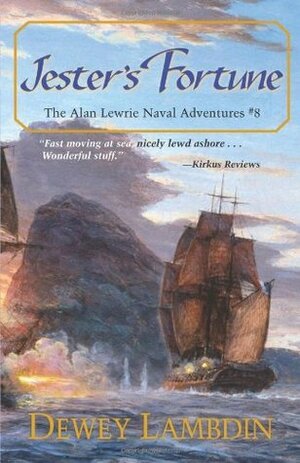
Jester's Fortune, Dewey Lambdin (Alan Lewrie series #8)

Not a great one to start the year off with, but it was a relaxing light read. Lambdin is clearly inspired by Patrick O'Brian, but like all the O'Brian imitators, he doesn't measure up, really. His prose is much weaker, his characters more flat, his humor less humorous, his grasp of the period's language less firm. (He really likes to use the adjective "shitten.") Yet I hold a little warm regard for the main character, who seems as if he were originally inspired by George MacDonald Frasier's cad Flashman, but Lambdin just wasn't able to keep Lewrie so terrible. By this novel, Lewrie has really grown up, and is starting to develop into a good leader with a real desire to be a better man.

I realized partway through that I'd accidentally skipped a book. It seems that #7, King's Commander, is not available on Kindle from Amazon Japan for some reason. Will I go to the trouble of tracking it down? Probably not. It says a lot about this series that I don't feel like I really missed anything.

Lambdin would also have done well to have followed O'Brian's lead on writing postscripts or forwards or other commentary on his own work: generally, just don't do it, but if you must, don't turn it into a blog post full of personal opinions about this and that. It doesn't really come across well. It's too bad, because there are some notes there about the historical events that inspired the story, and those are interesting. 

Currently reading: 

  • Beloved by Toni Morrison (audio, read by the author): This is a reread for the Kuala Lumpur Speculative Fiction Book Club, and I'm half loving it--it really is so good!--and half not wanting to continue--it really is such a dark, sad, painful story! 
  • A Wizard's Guide to Defensive Baking by T. Kingfisher (print): I started this awhile ago, got busy, and have returned to it after finishing Jester's Fortune. It's...OK. I'm not the target audience, and I probably would have LOVED it as a pre-teen, but considering that its main theme is how bigotry and fear can be harnessed to take power, and I'm reading Beloved at the same time which deals with much the same thing in a MUCH more realistic and abject manner, it makes this book feel very trite. Not Kingfisher's fault, of course. I'm just kind of reading it to finish reading it, at this point.
  • The Future of Another Timeline by Annalee Newitz. This is the first novel of Newitz's that I've read, though I've read plenty of their nonfiction and a couple of short stories. When I was attending a panel they moderated at VICFA (the Virtual International Conference on the Fantastic in the Arts) a few months ago, I remembered that I needed to read more by them, and bought this one while listening to the discussion. I've barely started it, but it looks good so far.